

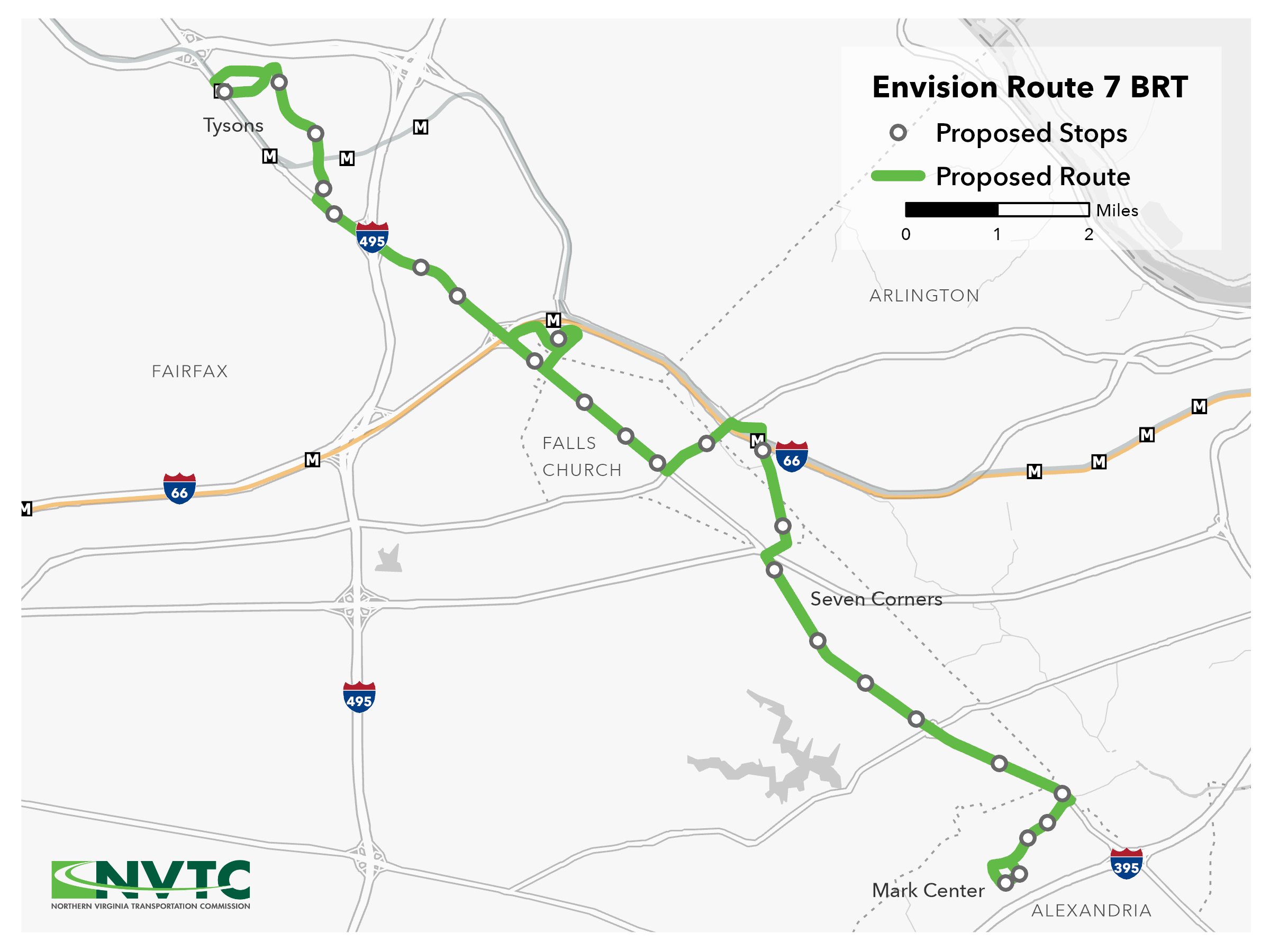
NVTC leads the planning process for Envision Route 7, a Bus Rapid Transit (BRT) system designed to connect the Mark Center in Alexandria to Tysons via Bailey’s Crossroads, Seven Corners and Falls Church along the Route 7 corridor.
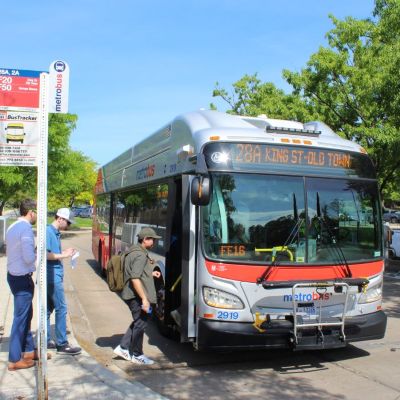
Route 7 is a varied roadway within a 14-mile corridor spanning four jurisdictions (Alexandria, Falls Church, Fairfax County, and Arlington County). It contains diverse communities, connects residents to jobs and opportunities and is currently served by multiple bus routes. The Metrobus F20 serves a majority of the corridor with 12-minute daytime frequency.
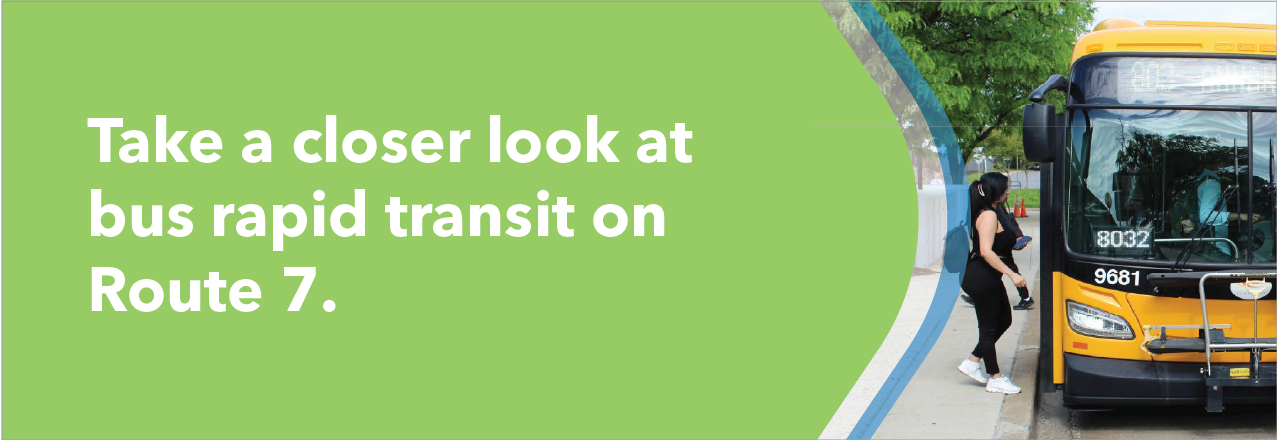
Route 7 is the second busiest bus corridor in Northern Virginia, with ridership that remained strong during and after the COVID-19 pandemic.
BRT on Route 7 will:
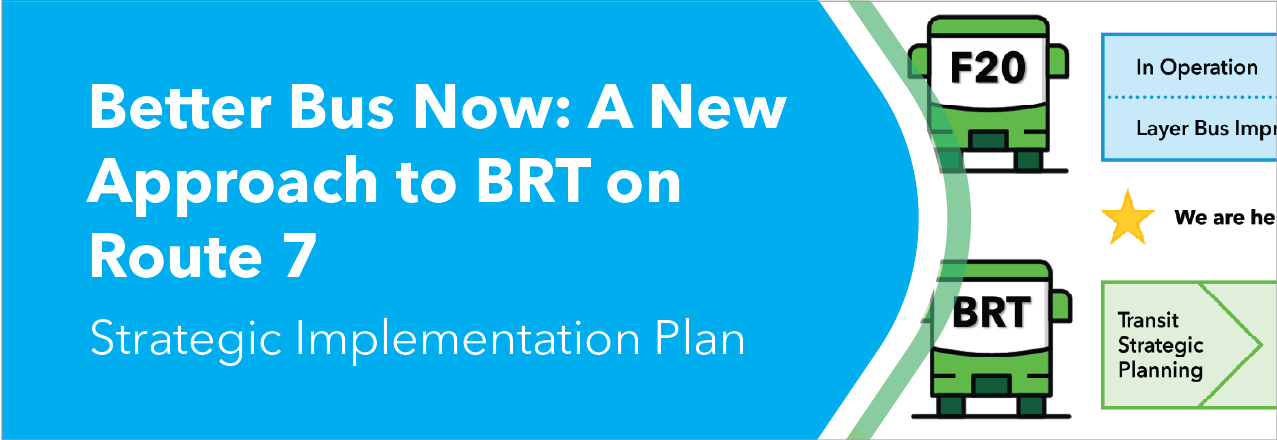
We are in Phase 4: Mobility Analysis, which divides the corridor into three segments to determine the benefits and impacts of the proposed BRT. Learn more about Phase 4.
This phase aims to:
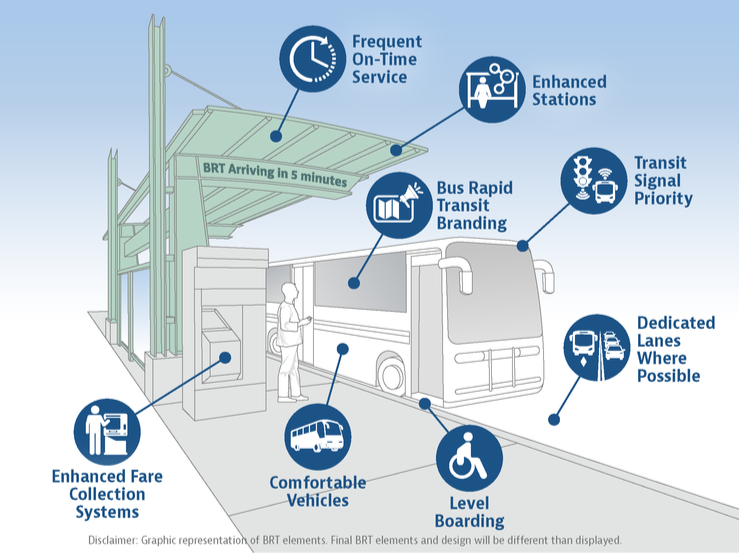
What is bus rapid transit?
Bus rapid transit (BRT) is a high-quality, bus-based public transit system that is designed to deliver fast and efficient service.
BRT may include dedicated lanes, traffic signal priority, off-board fare collection, elevated platforms and enhanced stations.
Designed with rail-like features such as dedicated lanes, BRT can deliver fast, frequent and reliable transit service along a fixed route with the flexibility of a bus.
Phase 4-2: Mobility Analysis-Seven Corners to Mark Center/Southern Towers Transit Center (ongoing)
The Phase 4-2: Mobility Analysis will examine the segment from Seven Corners in Fairfax County to the Mark Center/Southern Towers in Alexandria, completing the corridor’s mobility analysis.
This phase supports NVTC’s Envision Route 7 Strategic Implementation Plan strategy to identify near-term, targeted enhancements to existing bus service on Route 7 and detail opportunities for funding those improvements, while continuing to lay the groundwork for the more capital-intensive work to implement true BRT service on Route 7 in the future. Phase 4-2 will build off previous analysis by NVTC and the Fairfax County Department of Transportation and include the following study objectives:
- Identify trends and examine issues related to traffic congestion by collecting and analyzing data to understand the operational impacts of center running vs. curb running BRT along the study corridor.
- Facilitate community conversations around BRT on the project corridor.
- Conduct analysis in the City of Falls Church regarding Business Access and Transit (BAT) vs. High Occupancy Vehicle (HOV), queue jump layout/cross-section.
- Resolve the southern terminus of the BRT in Alexandria (Southern Towers vs. Mark Center).
Additionally, NVTC will work with project partners by providing a coordination forum to resolve:
- North Sycamore Street/North Roosevelt Street bus priority in Arlington.
- Metrobus F20 (formerly Metrobus 28A) and BRT alignments in Fairfax County and Alexandria.
- Transit connectivity between Columbia Pike and Route 7 bus routes.
Determining the benefits and impact of the Envision Route 7 BRT on future roadway operations along the corridor is important for building consensus and support in the community.
Phase 4-2 began in May 2025 and will take approximately 12 to 18 months to complete.
Phase 4-1: Mobility Analysis-West Falls Church Station to East Falls Church Station (2023)
Phase 4-1, led by NVTC and completed in fall 2023, provided a detailed mobility analysis of approximately 3.5 miles of the project corridor from just south of I-66 through the City of Falls Church and Arlington County to Seven Corners. The study developed three bus priority scenarios that document a range of improvements to bus operations along the segment. NVTC is working closely with the City of Falls Church and Arlington County to integrate the bus priority treatments identified in Phase 4-1 into their own jurisdictional plans.
This phase was conducted by Fairfax County. In 2023, the Fairfax County Board of Supervisors formally adopted Route 7 (BRT) in the Comprehensive Plan, endorsing bus priority infrastructure from Spring Hill Station, via International Drive to Route 7, continuing south to I-66 and reaching West Falls Church Station. NVTC considers this work along the western portion of the corridor as Phase 4-0, placing it within the ongoing planning efforts that evaluate geographic sections of the corridor. In this portion of the corridor, Fairfax County plans to implement median running lanes on Route 7 and International Drive, use business access and transit (BAT) lanes on the Spring Hill Road and Tyco Road couplet, and operate in mixed traffic in the remaining segments around Tysons. This infrastructure plan will require the widening of Route 7, from four lanes to six lanes, from Haycock Road to I-495 to maintain existing service commitments.
Phase 3: Conceptual Engineering (2019)
Phase 3 was a conceptual engineering study that refined the project cost, identified potential areas of concern and provided guidance on preserving the required right-of-way. It developed planning-level drawings of the BRT alignment, right-of-way requirements and roadway design along the corridor. By identifying right-of-way that would be utilized by the BRT, this phase informed jurisdictions in their land-use planning.
Phase 2: Alternatives Analysis (2017)
The Alternatives Analysis determined which mode of travel would best serve the Route 7 corridor and where and if the bus rapid transit (BRT) system should deviate from Route 7.
The study concluded that BRT along Route 7 from Tysons to the Mark Center/Southern Towers in Alexandria, via the East Falls Church Station and Seven Corners, is a viable transit solution for the corridor.
This phase:
- Estimated the potential demand and forecast the ridership.
- Compared possible alternative modes, such as light rail (LRT).
- Determined possible funding mechanisms and strategies
- Provided an initial cost estimate for capital and operating costs.
The study found that BRT would serve ridership across all trip purposes for less cost than LRT. The BRT service would provide commuters with key connections to Tysons, Mark Center/Southern Towers, and Metro as well as provide access for shopping and recreational trips.
Phase 1: Setting the Stage (2013)
Setting the Stage was a high-level planning effort that identified needs along the corridor, the context of the corridor and initial alternatives that could be explored in later phases.
NVTC works closely with Alexandria, Falls Church, Fairfax County and Arlington through the project development process.